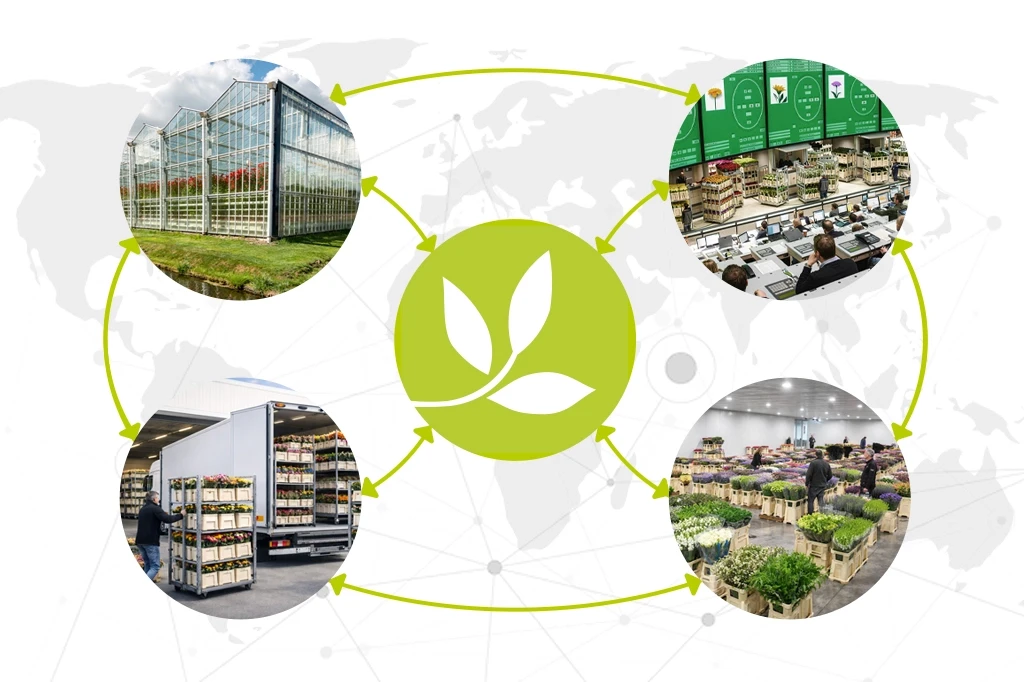
The future of floriculture is not built on software. It is built on shared language and connected systems.
Share this article
The real complexity lives between companies, not within them
Within the floriculture sector, digitalization is still too often approached as a question of internal optimization. Companies invest in ERP systems, order management, and logistics tools with the aim of making their own processes more efficient. What is consistently overlooked is that the real complexity does not sit within the company, but between companies. The sector operates as a chain of growers, exporters, importers, and retailers who depend daily on each other’s data. Without a shared structure to exchange that data, every optimization remains local, and friction emerges exactly where speed and transparency are most needed.
Standards are not a compliance requirement, they are the only path to scale
The role of standards is often underestimated in this context. Many parties see standards as a technical agreement or a compliance requirement, something necessary just to allow systems to communicate at all. In reality, standards are the only way to create scale and reliability in a fragmented international chain. They ensure that a product, an order, or a logistics status does not need to be reinterpreted each time. That is not a detail, but a condition for speed, error reduction, and ultimately margin protection in a market where every minute counts.
Floricode plays a fundamental role by developing and managing these standards for the floriculture sector. This goes beyond defining product codes or message structures. It is about establishing a common language that is understood across the entire chain. Without this language, every integration becomes custom work, every connection becomes fragile, and every expansion of the network becomes exponentially more complex. This is precisely why many digitalization initiatives in the sector stall once they move beyond the boundaries of the individual company.
From building blocks to working infrastructure: the API-first shift
What is often not explicitly stated is that standards alone do not form infrastructure. They are the building blocks, but without a layer that operationalizes these standards between systems, their impact remains limited. This is where the core shift in the sector becomes visible. The question is no longer whether systems can exchange data, but whether they can do so in a scalable, standardized, and real-time way without continuously building new integrations. This requires a different approach to technology, with API-first thinking at its center.
An API-first approach means that systems are no longer closed environments that occasionally connect, but open components within a larger network. Data is no longer exported and imported, but continuously made available and retrieved within a shared structure. When these APIs are based on standards, a situation emerges where every new participant in the chain can immediately communicate with existing parties without additional translation layers. This is the point at which scalability becomes real, and the sector can evolve from a collection of isolated links into a connected ecosystem.
FreshPortal: putting standards to work
FreshPortal has been built from this reality. Not as another system adding to existing complexity, but as an infrastructure layer that operationalizes the use of standards and APIs in daily operations. By fully aligning with industry standards and making them centrally available through an API-first architecture, it becomes possible to directly connect the systems of growers, exporters, and buyers. This means that information on availability, orders, and logistics is no longer fragmented across different systems, but flows consistently and in real time across the chain.
The impact of this becomes most visible when companies attempt to scale internationally. In a market where products move across borders and every party operates different systems, interoperability becomes the defining factor for growth. Companies that rely on custom integrations quickly hit a ceiling as the number of partners increases. Each new relationship introduces new technical dependencies and delays. In an API-first environment based on standards, that limitation disappears, and expansion becomes a matter of connecting rather than rebuilding.
Standardized data as the foundation for AI and smarter decisions
At the same time, a standardized and connected infrastructure opens the door to data-driven decision-making. When data flows consistently and reliably across the chain, it creates the foundation for AI applications that can better align supply and demand, optimize logistics decisions, and reduce waste. Without standards, data remains fragmented and incomparable, limiting any advanced analysis to isolated silos. The value of AI in floriculture is therefore directly dependent on how standardized and connected the underlying data infrastructure is.
Standards as a strategic choice for future-proof growth
The discussion around standards must therefore shift from a technical to a strategic context. The question is not whether a company is compliant with standards, but whether it wants to be part of a scalable, future-proof chain. Companies that embrace standards and combine them with an API-first approach position themselves within a network that can grow and adapt. Those that do not remain dependent on manual processes and ad hoc integrations that will ultimately undermine their competitiveness.
The floriculture sector has reached a point where further growth and efficiency can no longer be achieved through internal optimization alone. The next step lies in connecting the chain as a whole. Standards provide the shared language, but without infrastructure that actively enables that language, their potential remains untapped. The combination of Floricode standards and an API-first infrastructure such as FreshPortal offers a direction in which the sector can evolve into a truly integrated and scalable system. This is not a technological choice, but a structural condition for the future of international floriculture trade.